
Plainfield Previous Residents by Record Era
Previous residents of one Plainfield address come into focus only when the record is matched to its period and purpose. A modern tax or parcel result helps anchor the place. A deed chain identifies transfers of an interest in land. A historical directory can place a household at the street number in a particular year. Census, maps, permits, newspapers, cemetery evidence, probate, and archival papers provide different checks. No one of them is a complete list of everyone who lived there. Start with the strongest source for the year you need, then carry the address and its block and lot backward.
| Source | Years It Covers | Where Held | What It Shows |
|---|---|---|---|
| Union Clerk online land index | June 1, 1977 through current | Web name index | Recorded instruments and published images where available |
| Union Clerk Record Room | 1857 through current | Elizabeth counter | Land transactions, maps, older books, and staff assistance |
| NJ Archives deed microfilm | County deeds through 1900 | Trenton and FamilySearch channels | Earlier grantor and grantee books |
| Plainfield directories | 1870s through 1982, with gaps | Library and DigiFind-It | Annual address, occupant, occupation, and business snapshots |
| New Jersey state census | 1865, 1885, 1895, 1905, 1915 | Library microfilm | Household and population bridge between federal census years |
| Federal census | 1850 through 1950 currently released | Library databases and national sources | Enumeration household details under the 72-year release rule |
| Sanborn map | 1892, 21 sheets | Library of Congress | Building footprint, use, and street context |
| Plainfield newspapers | Digitized 1837 through 1918; later Courier News microfilm | Library and DigiFind-It | Sale, building, obituary, and social notices |
For a recent transfer, start with the current parcel anchor and the Clerk index. For an older address, bring the block and lot to the Record Room, then pair the land result with a directory year and census evidence. When the question is a building change rather than an ownership change, request City UCC or Inspections material by exact address and date range. The former FastTrack portal is closed, so the documented alternatives are a city counter, phone contact, a specific request, or an OPRA route.
Start Plainfield Previous Residents With a Parcel
A Plainfield address can change street form while the underlying land record continues through its legal description. Begin with the City Tax Collector search, which accepts a block and lot, account number, or street address. The tax portal notes that street suffixes can be abbreviated, so try the documented spelling variants. Save the situs address, block, lot, qualifier, and the date checked. A situs address identifies the parcel. A mailing address is where notices are sent and is not proof that someone lived at the property.
Use the Union County Public Map to orient the parcel with roads, blocks and lots, wards, districts, zoning, cemetery layers, and adjacent geometry. The city assessor is a separate counter channel at 515 Watchung Avenue, 908-753-3203. A verified city owner-name web search was not found in the research, so do not invent one. NJGIN's Property Explorer information is another parcel-data channel, subject to Daniel's Law redactions.
Note: Keep the street address and legal description together because old deed books key to legal land language, not modern delivery labels.
Trace Plainfield Previous Residents Through Deed Chains
The Union County Clerk Online Public Land Records index is a name search, not an address search. Once the parcel anchor identifies the current owner and legal description, search the current owner as a grantee for the purchase that put the property into that person's name. The seller in that instrument is the grantor. Then search that seller as a grantee during an earlier period to find the previous purchase. Repeat the process and compare the block, lot, plat, instrument, and book and page at every turn. A chain is strongest when each transfer keeps the same legal description.
- Record the current tax or assessor anchor: the situs address, block, lot, qualifier, and owner name as displayed or confirmed at the counter.
- Search the current owner in the Clerk name index and find the acquisition instrument that matches the property description.
- Write down the deed date, recording date, grantor, grantee, instrument number, book and page, and consideration if it is visible.
- Search the former grantor as a grantee in an earlier range, then verify that the same legal description continues backward.
- Repeat the handoff from seller to earlier buyer. Add linked mortgages or releases only when they help explain the transfer.
- Move to the Record Room, archival microfilm, maps, and subdivision plans when the relevant transaction predates web coverage or lacks an image.
- Grantor
- The person or entity transferring an interest in the deed being read.
- Grantee
- The person or entity receiving that recorded interest.
- Chain of title
- The sequence of transfers traced from one recorded owner to an earlier one.
- Legal description
- The block, lot, plan, or other land description that ties older deeds to the same parcel even when street wording changes.
Plainfield Previous Residents in the Clerk Index
The Clerk's help materials explain the actual fields available for the earlier-record search. Try surname spellings with Exact, Starts With, or Soundex choices and use first name when it helps separate matching parties. A date range cannot exceed 31 days, so a broad historical project needs short, intentional searches. Results can include a party name, document type, recording date, book and page or year and instrument placement, and an image icon when a published image exists. The portal itself advises checking spelling variants and limits use to 150 searches per hour and 500 per day.
| Last name | Required for Name Search; use Exact, Starts With, or Soundex and repeat meaningful spelling variants. |
|---|---|
| First name | Optional in Name Search; Exact or Starts With choices can narrow a shared surname. |
| Document type | A dropdown in Name, Date Range, Book and Page, and Instrument searches; the full live option list was not exposed in research. |
| From and To | Optional in Name Search and used as dates where applicable; date-range searching is limited to 31 days. |
| Book and page | Required together in that search mode, along with document type. |
| Instrument year, number, suffix | Required in Instrument Number Search, along with document type. |
The index is an entry point, not a complete evidence file. Published public images can be limited, and the registered full-view service is stated as $600 for one year for up to five users. Confirm the document at the Record Room if a result is incomplete, if the image has not been added, or if the legal description is unclear.
Plainfield Previous Residents Beyond Web Records
The online Clerk index starts June 1, 1977. The Union County Clerk Record Room reaches land transactions from 1857 to the present, so it is the required next stop for an older Plainfield deed chain. The Recording Office is at 2 Broad Street in Elizabeth, and the research lists its public counter hours as Monday through Friday, 8:30 a.m. to 4:30 p.m., with no appointment required for the recording counter. Call 908-527-4787 before a long visit and bring the address, block and lot, date range, and known party names.
For older books, also use the New Jersey Archives genealogical collections and the Plainfield library database list for FamilySearch Affiliate access. County deed microfilm reaches through 1900, but image availability and indexing vary. Clerk maps and subdivision plans are another counter source when a property divided or changed number. The research did not locate a dedicated current city house-history service or a verified permit-archive date, so those records should be requested by address and time period rather than described as a ready-made online search.
Use the Union County certified-copy request page when a result needs a formal copy.
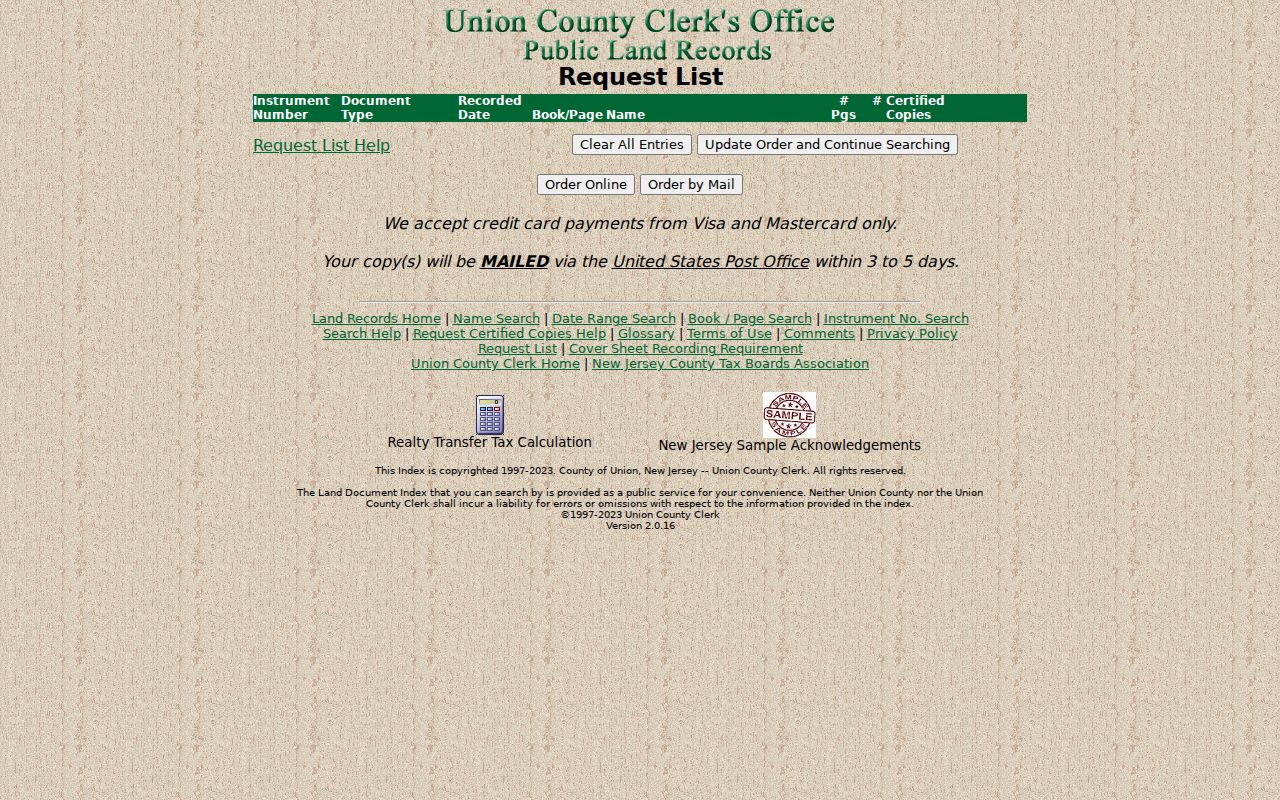
The request list records instrument number, document type, recording date, book and page, party name, pages, and copies. Visa and Mastercard are listed, and mail processing is stated as three to five days; the inspected page did not display an exact copy fee, so confirm that amount before ordering.
Pair Plainfield Previous Residents With Census Records
Ownership is not the same as occupancy. To see who lived at a Plainfield address, use the nearest available directory, then compare it with the federal census release and New Jersey state-census microfilm. The directory gives an annual address and often a relative notation or occupation. A census schedule records the household on its enumeration date. The collection details and entry conventions are available in the Plainfield Directory Book, while this address trail uses those entries as one layer beside deeds.
- Choose the directory year nearest to the transfer or the date of interest, then record the address exactly as printed.
- Search the street section as well as the name entry, especially if the number, street suffix, or former street name is uncertain.
- Pair the result with released federal census years, including 1870, 1880, 1900, 1910, 1920, 1930, 1940, and 1950 where the household timeline fits.
- Use the library's 1865, 1885, 1895, 1905, and 1915 New Jersey state-census microfilm to fill an interval between federal census dates.
- Check newspaper notices, obituaries, cemetery evidence, or probate separately when a person disappears from the address trail.
Open the Plainfield directory year selector to begin with a particular volume.
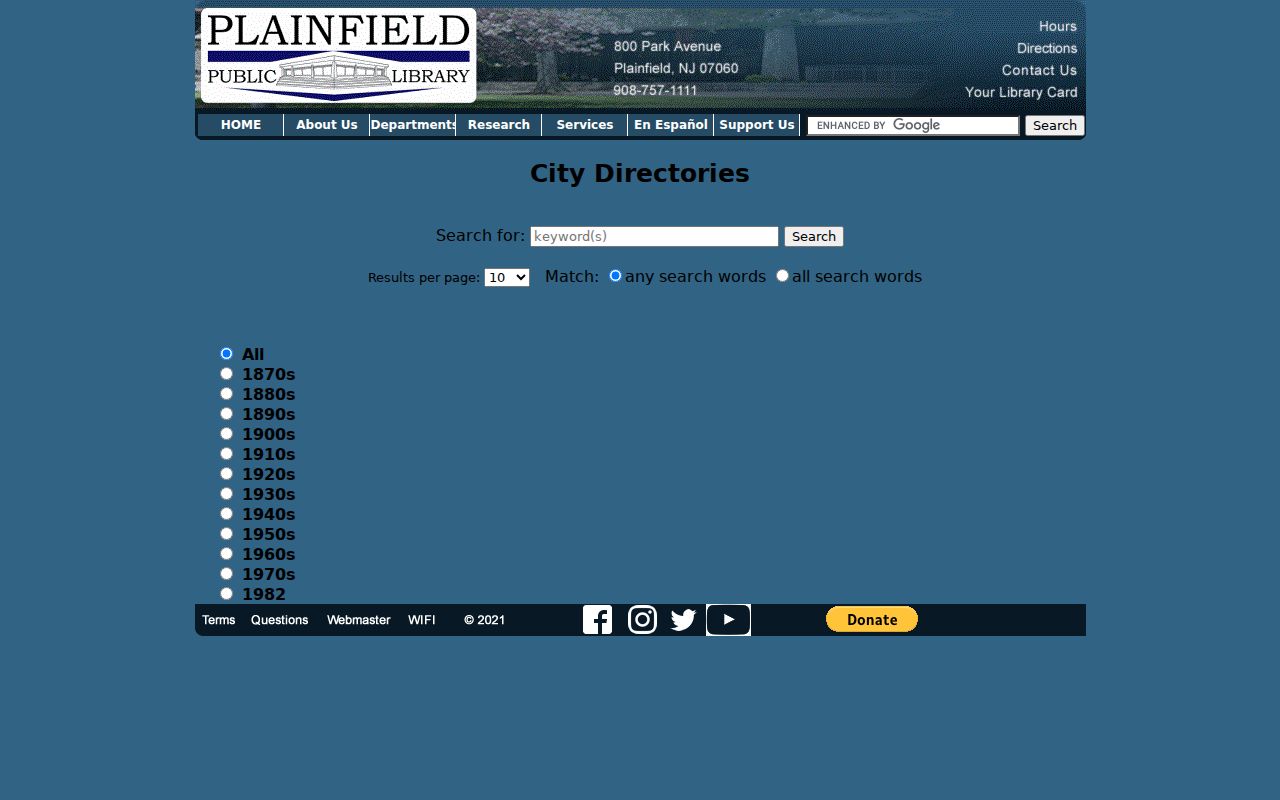
The selector supports a year-by-year approach, which is safer than treating one directory appearance as a continuous statement about who lived at the address.
Plainfield Previous Residents and Former Street Names
Address continuity is a local research problem, not a minor spelling issue. The 1887 Plainfield directory expressly identifies Essex Street as formerly Division Avenue and supplies left and right address ranges and cross streets. The 1891 directory gives beginning and end points for streets, and its listings include some North Plainfield streets. Search both Essex and Division when the historic period calls for it. Keep a note showing which name occurred in which source and year.
Do not rely on a ZIP or postal city label to settle municipal identity. The 1977 directory describes a broader trade area that included nearby municipalities, which is commercial geography rather than a city boundary. Reconcile a historical number with the block, lot, plan, or legal description when possible. This is especially important when past residents appear to move only because a street label, numbering pattern, or municipal reference changed.
Note: An old street label can be the key to a directory or newspaper result that does not appear under the modern address.
Map Plainfield Previous Residents in 1892
The 1892 Library of Congress Sanborn map set covers Plainfield and North Plainfield in 21 sheets. It can show the building footprint, construction or use cues, street geometry, and adjacent structures for the mapped year. Place the map beside the 1891 street directory section and the current Union County parcel layer. That three-way comparison can show whether an address was part of the same built site, whether the street layout changed, or whether a nearby landmark helps identify the right block.
A Sanborn sheet does not name every past resident and it does not replace a deed or directory entry. It is a dated place record. Save its sheet number and compare the address forms carefully. For later construction, additions, conversions, or inspections, request City UCC or Inspections records by exact address, block and lot, and date range. The city material supports that request channel but does not document a public complete online permit index.
Plainfield Previous Residents Beyond Formal Records
Formal land and address records sometimes leave a personal gap. The Plainfield Public Library local-history collections include oral-history resources, including Plainfield Voices interviews about the 1967 Plainfield Uprising and materials reflecting African-American, Latino, and Hispanic community history. These sources can preserve a former resident's memory of a block, school, congregation, or family move when an official record names only an owner. They are context, not a substitute for a parcel, deed, or directory citation.
The Drake House family papers reach from 1761 through 1969 with gaps, and its ephemera collection reaches from 1830 through 2017 with gaps. Funeral cards, calling cards, programs, photographs, clippings, and personal papers can supply a useful lead. Request access by surname, street, and date range, and follow supervised-access and copyright rules. A precise request is more useful than asking an archive to identify everyone associated with an address.
Close a Plainfield Previous Residents Trail Carefully
The end of an address trail may be a sale, a death, a move, a demolition, or simply a gap in the surviving sources. Plainfield's 1930 directory contains numerous death annotations that can lead to an obituary search, but a vital record is protected and cannot be searched as a public web index. Use the relevant registrar or state route for a certificate, and check the Union County Surrogate for a probate or estate file when a death or heir relationship affects the next deed. Ask for the estate name, file number if known, date range, and whether you seek a will, inventory, account, or letters.
For a city record that is not online, a focused New Jersey Open Public Records Act request should identify the custodian, address or block and lot, record type, date range, and desired format. OPRA requires a response as soon as possible and no later than seven business days for available records, subject to the documented review exceptions and lawful copying or service charges. Protected addresses and personal fields can be withheld.
Lawful use. Plainfield previous-resident research fits family history, estate work, local history, and personal property curiosity. Do not use records or archive material to stalk, harass, or harm a living person.