
Plainfield Resident Lookup Record Coverage
Different records answer different identity questions. A tax bill and parcel map can tie a name to land, while a deed can show a recorded role and date. Voter status can place a person in an election system, subject to redactions. A court result can distinguish a party through a docket and case type. Vital records answer event and relationship questions, but current New Jersey certificates are not an open name-search system. Use more than one record before treating a match as the right Plainfield resident.
| Record | What it can confirm | Plainfield or state keeper | Access route |
|---|---|---|---|
| Tax bill and assessment | Property situs, block/lot, owner of record, tax mailing address | Plainfield Tax Collector and Assessor | Address, block/lot, or account search; owner-name web search was not located. |
| Parcel geography | Parcel shape, adjacent lots, roads, ward/district, zoning | Union County and NJGIN | Union County Public Map; reference data, not a legal survey. |
| Recorded land document | Party role, recording date, instrument, legal description | Union County Clerk | Web index from June 1, 1977; Record Room transactions reach 1857. |
| Voter status | Registration status and election geography where public | NJ Division of Elections and Union County BOE | State status check or a targeted county request. |
| Court case | Party, docket, case type, dates, listed proceedings and status | NJ Courts, Plainfield Municipal Court, Union Vicinage | Find a Case, public terminal, or clerk/records-center request. |
| Vital event | Birth, marriage, death, or related legal event | Plainfield City Clerk or NJ Department of Health | Restricted certificate or historical route, not a public current-name index. |
When an address is known, begin with the tax and parcel routes. When only a name is known, build a small identity key first, then test that name in the voter, court, deed, or historical channels that fit the time period. A tax mailing address is a notice address, not proof that the owner lives there. Likewise, a recorded deed establishes a recorded party and property connection, not current occupancy.
Note: Preserve the search date and the exact identifier, such as a block/lot, instrument number, or docket number, with every result.
Plainfield Names Need an Identity Key
A careful resident lookup begins by writing down the full name, middle initial, approximate year, known address, spouse or relative, business affiliation, and relevant time period. Plainfield records can use a married name, initials, an abbreviation, or a Plainfield postal label attached to an address outside the city. That small set of facts gives a way to compare results without guessing.
The Union County Clerk recommends spelling variants in its deed index. Record each party’s role rather than treating every hit as a match. A grantor transfers an interest, while a grantee receives one. Compare the deed’s legal description with the parcel block and lot. For historical identity work, a later directory, newspaper, probate file, or state-census entry may add the family connection that a modern parcel result lacks.
Verify a Plainfield Resident Across Records
Use a sequence that asks one narrow question at a time. The sequence below is designed to check a current or recent Plainfield connection. It does not turn a property record, a docket, or a registration result into a household list.
- Start with the official state voter status tool for the registration question, or ask the Union County Board of Elections for a specific election record if the public result is insufficient.
- When an address is known, use the Plainfield Tax Collector search, then confirm the parcel’s block and lot on the Union County map. For a name-only question, ask the Assessor or City Hall counter for the lawful owner-record route.
- Search the Union County land index with exact, starts-with, Soundex, and spelling variants. Match the recorded party, date, instrument, and legal description to the parcel instead of relying on a similar name.
- Use the state court hub for a matching party name, then compare county, case type, docket, and disposition. Request a copy from the proper custodian when the public screen does not include the needed document.
- Docket
- A court’s identifying number for a case. It helps distinguish similar names by county, case type, year, and case sequence.
- Index and image
- An index is a searchable list of record details. An image is the scanned record itself; it may be unavailable online even when an index entry appears.
- Certified copy
- A copy issued by the custodian with the certification required for legal use. Eligibility, identification, and fees can apply.
- Disposition
- The recorded outcome or status of a court matter. A case filing alone is not a finding about a person.
For a whole-street question, use the separate Plainfield street directory route instead of extending a one-person verification into a block-wide claim.
Plainfield Court Results in a Resident Lookup
The NJ Courts Find a Case hub separates civil and foreclosure case jackets, criminal cases, criminal judgments, judgment liens, Tax Court cases, and municipal matters. Civil and foreclosure cases can be searched by party name or docket number. Criminal routes can use a name or county, and judgment searches can use party or judgment identifiers. Municipal access generally requires the ticket or complaint path for the person’s own matter.
| Identity fields | Party, defendant, or plaintiff name as entered; litigant status; and listed attorneys. |
|---|---|
| Case placement | County, docket type, docket number, docket year, and, in some criminal routes, indictment, CDR, SBI, or complaint identifiers. |
| Case activity | Case type, filings list, orders entered, scheduled proceedings, and motion or case status. |
| Dates | Filing, entered-document, proceeding, and disposition dates when the system displays them. |
| Limits | Public screens do not promise the filed document text or images. Sealed, expunged, juvenile, adoption, and protected Family Part material is not an ordinary public result. |
Plainfield Municipal Court is at 325 Watchung Avenue, with court code 2012 and phone 908-753-3064. Union Vicinage Superior Court is at 2 Broad Street in Elizabeth. A public Promis/Gavel inquiry terminal at each Superior Courthouse can provide an inquiry-only route when the simple web path is not enough. For closed Superior Court files, give the Clerk or Records Center the caption or party, docket, county, case type, year, and requested document. Copy and certification charges are case-specific. Federal cases for the Plainfield area use the District of New Jersey, Newark vicinage, through PACER, which requires an account and applies current federal page and document fees.
Plainfield Vital Custody and Eligibility
New Jersey vital records are not public records and cannot be searched online as a current resident list. For a Plainfield event, begin by confirming the local custodian with the City Clerk. Older city materials identify the Office of Vital Statistics at 510 Watchung Avenue, but municipal ordinance MC 2025-48 transferred vital-statistics responsibility to the City Clerk in 2025. Confirm custody, payment, and local timing before mailing an older form.
Current births under 80 years, deaths under 40 years, and marriages under 50 years follow non-genealogical rules. Certified copies require the listed relationship or other legal eligibility, identification, and supporting proof. Older genealogical windows follow a different route through the local registrar, the Department of Health, or archival holdings. A divorce decree belongs with Union Vicinage Family Part, not with a marriage-certificate request.
The New Jersey non-genealogical order page shows the state route for restricted current certificates and is the source captured below.
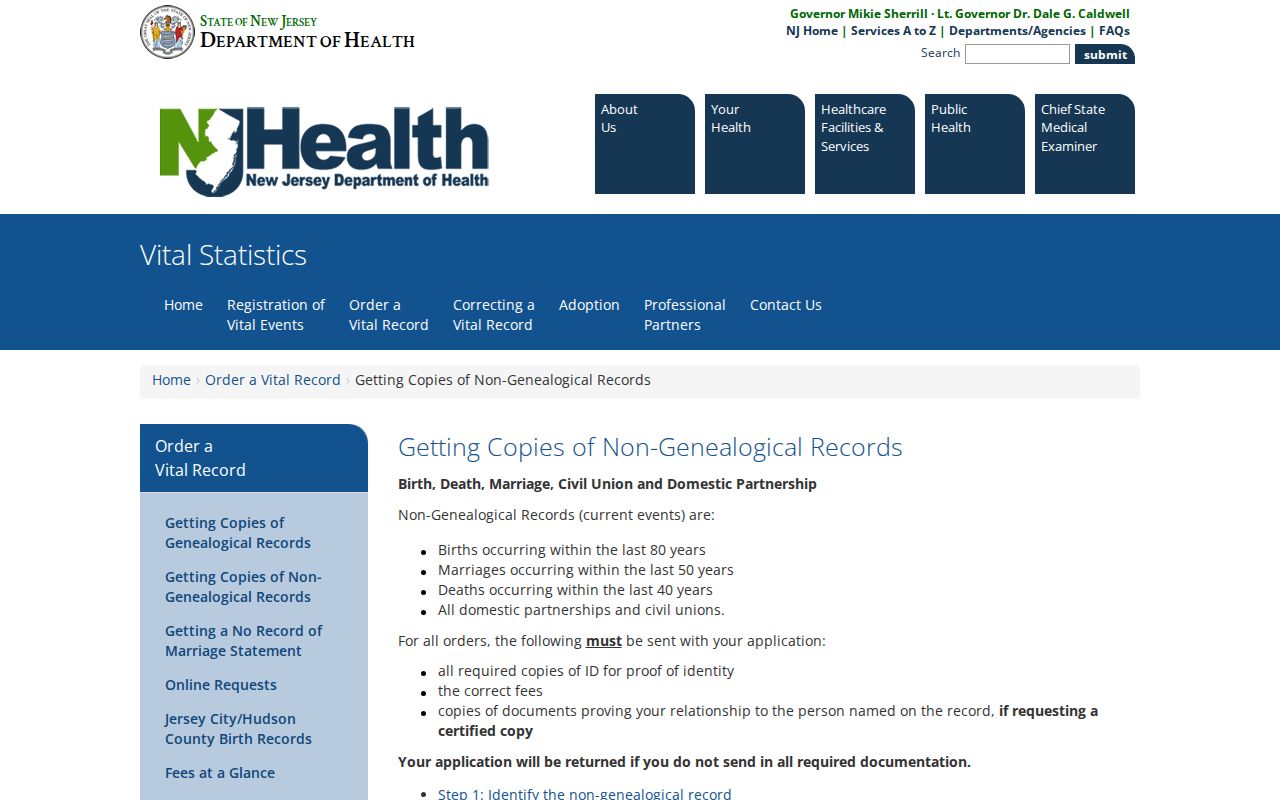
The state route uses the Office of Vital Statistics and Registry in Trenton. Mailed applications go to PO Box 370, Trenton, NJ 08625-0370, with check or money order made to Treasurer, State of New Jersey. The state reports online processing estimates of 6 to 8 weeks after approval and mailed estimates of 8 to 10 weeks. Its first-copy fee is $25 and an additional copy of the same record is $2; municipal fees may differ.
Note: An archival index, directory, obituary, or census entry can support historical research, but it does not replace a current certified vital copy.
Plainfield Voter Status in a Resident Lookup
The official New Jersey Voter Search, also called “Am I Registered?”, is the starting channel for a registration-status question. Its live form did not expose a verified field inventory during the research capture, so do not assume that the date-of-birth or identification fields used by the separate registration application belong to the public status form. Record only fields the live result actually displays.
Public election records can include name, residence or mailing address when maintained, party affiliation, municipal ward or district, and registration status, subject to exceptions. Signatures, Social Security numbers, driver-license or non-driver ID numbers, and protected addresses are withheld. Party affiliation is not a ballot record, and no voting choice can be inferred from it.
The New Jersey voter registration page links the state search and explains the broader registration channel shown in this capture.
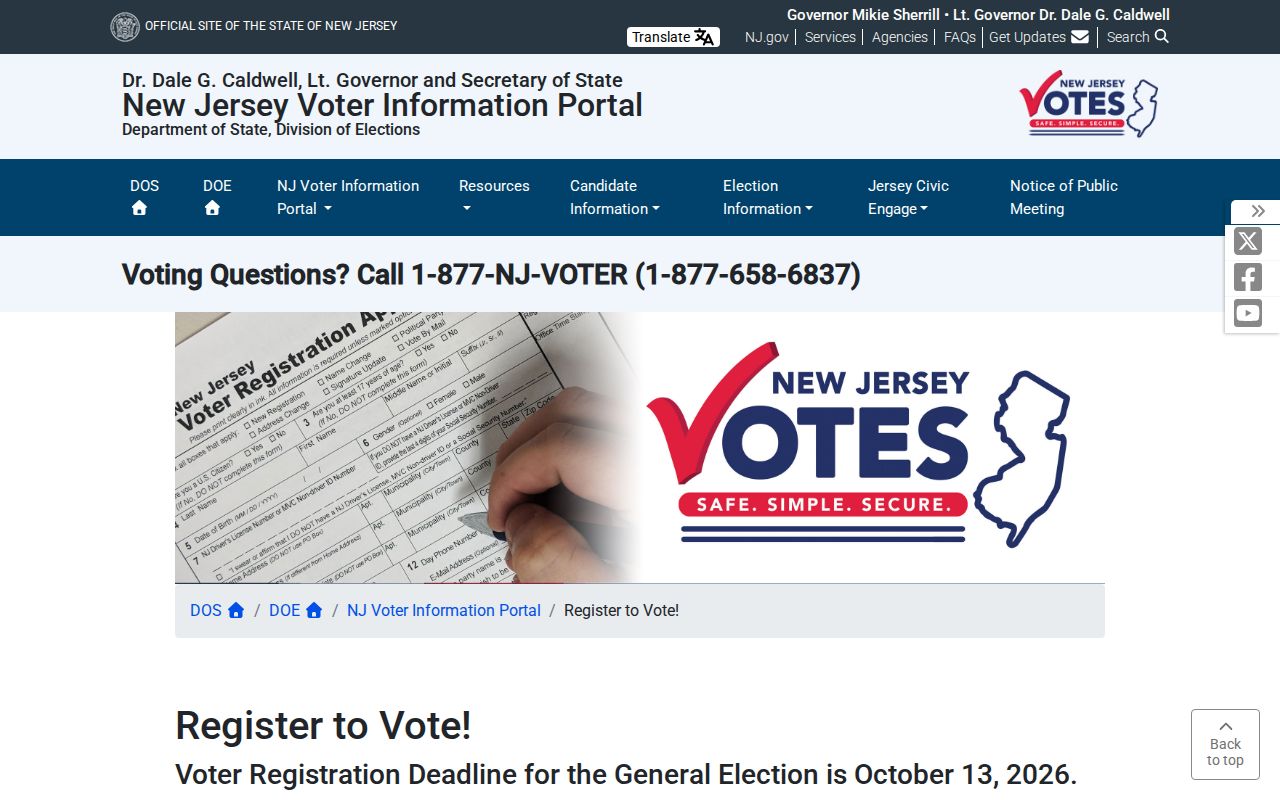
If a targeted record is needed, contact the Union County Board of Elections at 271 North Broad Street, Elizabeth, 908-527-4123, or ucboe@ucnj.org. Its official contact page provides English and Spanish election-document request materials. Ask for the current fee, format, redaction treatment, and any requested lawful-use certification rather than assuming an unrestricted file is available.
Plainfield Resident Lookup Counter and Mail Routes
When an online result is thin, use the office that holds the record. The Union County Clerk’s online land index starts June 1, 1977, while the Record Room holds land transactions from 1857. Pre-1986 imaging remains incomplete, so a name, date, instrument, and block/lot can move a request from a browser search to the Record Room. The state court hub can list a case, but the Superior Court Clerk or Records Center is the copy route for the actual file.
For an election record, the county Board of Elections has the counter, phone, email, and written-request path. For vital records, confirm the City Clerk for a Plainfield event, then use the state online, mail, or Trenton walk-in route if appropriate. A state walk-in center at 140 East Front Street accepts submissions on weekdays from 8:30 a.m. to 4 p.m., with a 3:30 p.m. submission cutoff. It will no longer accept cash after June 18, 2026.
OPRA, N.J.S.A. 47:1A-1 et seq., can be used for a specific existing record from the proper custodian. It does not require an office to create an analysis or override a confidentiality statute, court rule, or Daniel’s Law protection. Available records ordinarily receive a response as soon as possible and no later than seven business days; the statute provides a 14-business-day commercial or Daniel’s Law review period in the stated circumstances.
Plainfield Family Connections and Official Routes
Family research sometimes needs a person-focused route that is more careful than a broad name search. For an estate question, begin with the Union County Surrogate using the decedent’s name and date, then pair public probate material with deeds, an obituary, and an archival name-change or naturalization record. A post-death deed may identify an executor, heir, or grantee, but it still needs a date and parcel match.
For an adult adoptee or birth-parent question, use New Jersey’s official adult adoptee and birth-parent system. An ordinary certificate request does not open sealed adoption material. A former classmate trail can begin with Plainfield High School yearbooks and library collections, then be tested against a later directory. The Plainfield Library local-history holdings also preserve memories from African-American, Latino, and Hispanic communities, including Plainfield Voices interviews, when no address record survives.
Plainfield Resident Lookup Privacy Boundaries
New Jersey’s access rules leave important gaps by design. OPRA requires redaction of Social Security numbers, credit-card numbers, personal telephone numbers, driver-license numbers, and protected home addresses. Daniel’s Law can remove a covered person’s residence address and unpublished phone number from state, county, and local web records. A parcel can therefore remain visible while a protected owner name or address is not displayed.
The Address Confidentiality Program gives eligible participants a substitute legal mailing address, which government agencies must accept. It cannot erase an address already recorded publicly. Renters, non-owner household members, utility customers, and DMV addresses are not disclosed through the property chain. If a record appears wrong, contact the named custodian with the instrument, docket, or other citation and supporting documents.
Lawful use. Use a Plainfield resident lookup for personal, family, historical, or civic research. New Jersey law prohibits stalking and harassment, and records must never be used to intimidate, target, or harm another person.